


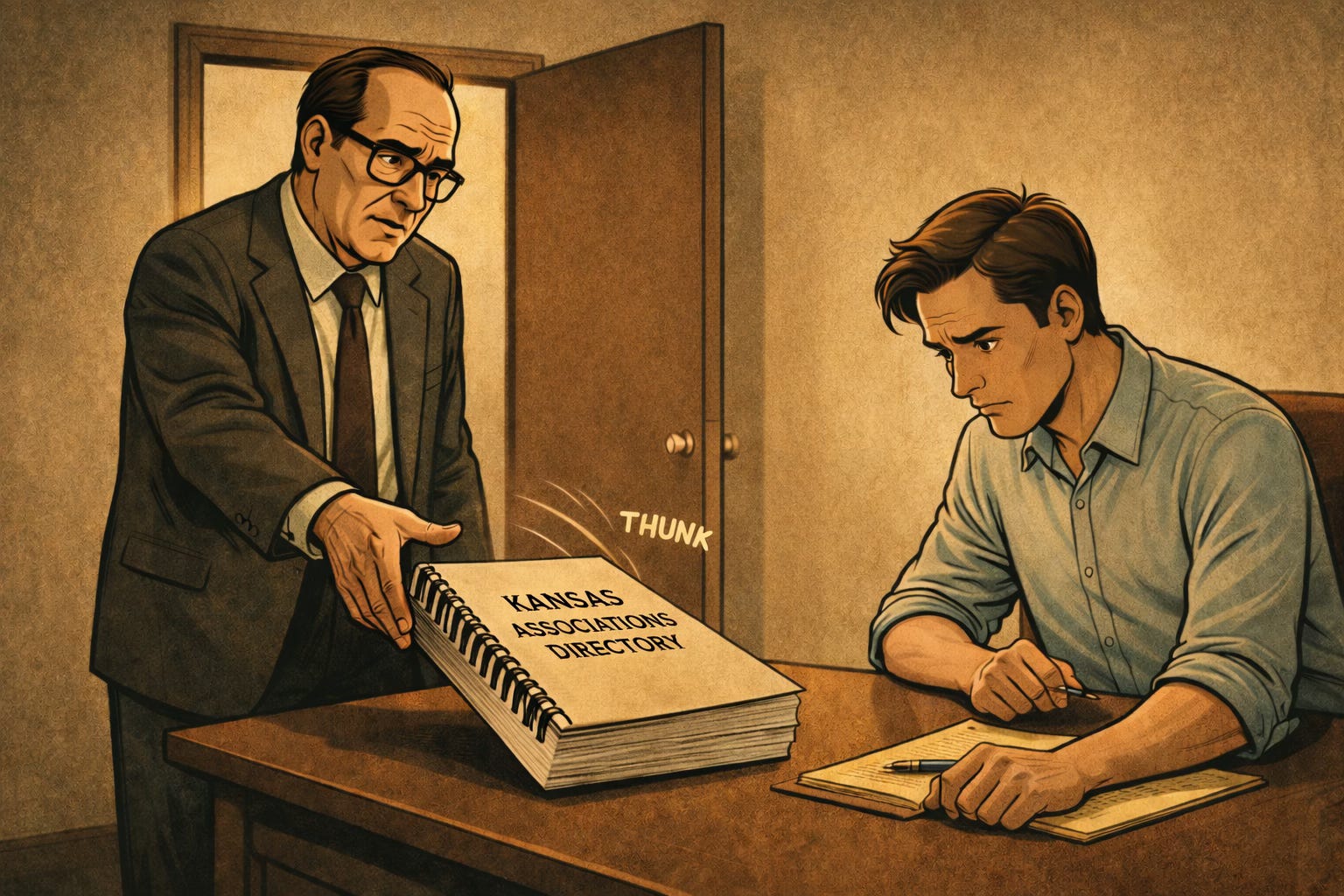
The director of sales was a friend who’d worked with me before at another hotel, so I thought I knew what I was walking into. I was wrong.
She walked into my office, dropped a directory of associations on my desk, and told me to start making phone calls.
I asked for some orientation and training first.
She shook her head, looked confused, and asked why.
I told her I’d like to know things like how many rooms we had, banquet capacity, catering options, room rates, and target pricing.
She scrunched up her nose and told me, “You don’t need to know any of that. Just start making phone calls.”
So I trained myself. I dug through old files and found contracts from associations we’d hosted years ago. I studied what they’d booked and what they were looking for. Before I picked up the phone, I met with every department manager in the hotel: front desk, catering, banquets, the head chef, maintenance, housekeeping. I wanted to see the hotel through their eyes.
What I heard was the same story, over and over: nobody had been trained. People were thrown into their roles and left to figure it out.
Later that week, the general manager pulled me aside. He’d heard I was making the rounds and wanted to know what I was up to. I told him what I’d found.
He vented about the hotel’s guest service scores. They were in the toilet. The brand was breathing down his neck. He might lose the Holiday Inn flag if things didn’t turn around.
At another hotel, as the Front Office Manager, I had taken guest service scores from the bottom of the barrel to the best they’d ever had in under three months.
I said, “Based on everything I’ve heard, the biggest issue is training. Everyone is frustrated that there’s a lot they don’t know and no one’s shown them what to do. If you want those scores to move, we need to put a training plan together.”
He looked at me and said, “We have so much turnover in our staff. It would just be a waste of time and money.”
“That is the stupidest management philosophy I’ve ever heard.”
I let the statement sit there in uncomfortable silence.
Not surprisingly, he let me go shortly after. And the Holiday Inn sign came down within a year.
I wasn’t sorry. Life’s too short to work for someone who sees investing in their people as a waste of resources. Build the skills to lead well, and you’ll never have to.
Closing the Gap
Expectations define success. Measurements reveal the gap. Training closes it.
Without clear expectations and visible measurements, training becomes scattered and disconnected from what’s holding the business back. With them, you can see who’s struggling, whether the whole team is falling short, and exactly where to focus.
If someone knows what’s expected and can see where they stand but doesn’t have the knowledge or skill to close the gap, you have a training opportunity. No amount of pressure, accountability, or feedback will fix it.
What Most Managers Get Wrong
Most managers would never say “training is a waste of time” out loud.
That general manager looked at the turnover and decided training wasn’t worth the investment. But he never saw that the turnover existed because no one invested in training. His people were embarrassed about what they didn’t know, overwhelmed, and frustrated. So they quit.
But plenty of managers operate from the same logic in subtler ways.
The most common version of this thinking is “It’s faster if I just do it myself.”
Teaching someone takes longer than doing the task. So you do it yourself. Six months later, you’re buried under work that should have been delegated months ago and your team still doesn’t know how to do it.
Another mistake is confusing orientation with training.
A lot of managers walk a new hire around, show them where things are, and call it training. That’s orientation. It doesn’t make them competent.
The next mistake is assuming experience means they already know.
You hire someone with ten years in the industry and figure they’ll hit the ground running. But ten years somewhere else doesn’t mean they know how you want it done here. If you don’t show them your way, they’ll default to whatever habits they had before and you’ll be frustrated by results that don’t match your expectations.
Then there’s what I call the curse of competence.
When you’ve done something long enough, it becomes automatic. You stop thinking about the individual steps. And because it feels effortless to you, it’s easy to assume it should be obvious to everyone else.
I discovered this when I was teaching one of my kids to drive. They were struggling with right turns. They were either clipping the curb or swinging too wide. I tried to explain it, and I realized I couldn’t. I don’t think about how to make a right turn. I just make it. I had to get out, drive it myself, and deliberately pay attention to every micro-decision before I could teach it.
That’s exactly what the director of sales was doing at that Holiday Inn. Room counts, banquet capacity, and pricing were second nature to her. So when I asked for training, it didn’t dawn on her that she was operating with a great deal of context I didn’t have. She’d forgotten what it was like to walk in and know nothing.
The last pattern is the insecure manager who hoards knowledge.
Some managers won’t train because they’re afraid of what happens if their people get too good. If everyone knows how to do what I do, what do they need me for?
They keep critical tasks close. And eventually, the business outgrows them. I’ve watched managers build up a team or location, then get passed over or pushed out because they couldn’t delegate, couldn’t develop anyone, and couldn’t keep up with the demands they helped create.
The most secure leaders don’t cling to tasks. They produce capable people.
How to Train Effectively
Training is the transfer of knowledge and capability.
It starts with knowledge. People need to understand the what and the why before they can execute. But most managers stop there. They explain the concepts, then act surprised when performance doesn’t change. That’s because people don’t perform concepts. They perform behaviors.
Behaviors are actions you can observe.
When someone falls short, you shouldn’t just tell them to “do better.” You look at the behaviors tied to that outcome and ask: which ones are missing?
This is where the distinction between knowledge and skill matters.
Knowledge is what you know. Skill is what you can do. It’s the ability to execute reliably under real conditions.
Someone can recite every step of your sales process and still fall apart in front of a live customer or client.
Your job in Law 3 is to move people from “I understand it” to “I can do it consistently.” Then eventually to “I can do it under pressure.”
Use the training process IDPOPS: Introduce, Demonstrate, Practice, Observe, Provide Feedback, Summarize.
Introduce the concept. Keep this tight. Give them the what and the why. Just enough to understand the standard and the reasoning behind it.
Demonstrate what it looks like. Model the behavior so they can see it done right, not just hear it described.
Practice. Let them do it in a low-risk environment. Role-plays, walkthroughs, dry runs. Practice is how they build their own “muscle.”
Observe as they apply this skill. Step back and watch them execute.
Provide Feedback on what you saw. Be specific. What they did well, and what could be improved.
Summarize the key points.
If you stop after the introduction, you just held a briefing. If you stop after the demonstration, you only performed in front of them. Training doesn’t happen until they practice, and it doesn’t stick until you observe, coach, and reinforce.
When training follows this progression and ties directly to your expectations and measurements, you’re not just running a training program. You’re building capability exactly where your business needs it most.
Same Problem. Different Mindset.
Remember the problem that general manager refused to fix? Here’s how I solved it at my previous hotel.
Guest service scores were near the bottom when I arrived, and my main task was to turn them around.
Corporate sent monthly reports with every question from the guest survey along with how we ranked against other Holiday Inns.
Expectations and measurements were already in place.
We were in the bottom 10% of Holiday Inn guest satisfaction scores nationwide.
During my interview, I sat in the lobby and saw the problem immediately. The front desk was consistently empty. Guests would walk up, stand there, and wait until someone finally wandered out from the back.
That’s when I watched one man come down from his room three separate times because his key wouldn’t work. Each time there was no one at the desk. He’d stand there waiting until someone appeared, recoded it, and sent him back upstairs without a second thought. By the third trip, he was irate.
That was the first problem to fix, because it was the first impression every guest had of the hotel.
I reframed the job. These are guests in your home. You are the host. Your job is to make them feel important and comfortable and their stay hassle-free.
Then we translated that into simple, concrete behaviors.
Someone always needed to be standing at the desk. Every guest got a smile and a greeting before they even reached the counter.
We held training meetings on Saturday mornings. We role-played check-ins, greetings, and problem situations. We drilled these behaviors until they became second nature.
I trained them to treat that entire arrival process like a choreographed dance.
When a call came in from a guest arriving at the airport, the front desk attendant took the name and sent a bellman in the shuttle to pick them up. The bellman greeted them by name at the curb: “Good morning, Mr. Smith. Let me grab that bag for you.” On the drive back, the bellman radioed the front desk: “I have Mr. Smith. We’ll be there in five minutes.”
The front desk pre-printed Mr. Smith’s paperwork, coded his keys, and had everything waiting.
When Mr. Smith walked through the door, the front desk already knew who he was. They greeted him by name, confirmed his ID and payment, had him sign, handed him the key, and got him on his way feeling like a million bucks.
Within the first month, those behaviors alone moved us from the bottom of the brand to roughly the top 30% on guest satisfaction. By the end of the third month, after training our way through the rest of the survey issues, we were performing in the top 10% of Holiday Inns nationwide.
Same situation. Same market. Added training. Different results.
This Week’s Directive
Build a simple grid. Across the top, list each of the key standards you’ve identified. Down the side, write the name of every person you manage.
Once you’ve filled in all your numbers, take a highlighter and mark every point where someone is falling short of the expectation.
If you look down a column and more than half the team is highlighted, that’s not an individual problem. That’s either a gap the whole team needs training on, or a standard that needs to be reexamined.
If you look across a row and one person is highlighted across most or all of the categories, you have an individual problem. That person needs focused attention.
Identify one to three behaviors that would have the highest impact.
Then design your training using the IDPOPS progression.
Follow the progression and observe whether they can execute. Repeat the steps until they can do it well.
Next up: Law 4. Once your people know what to do and how to do it, you need to make sure they have the right tools to execute.
What This Forges
When you train deliberately, you stop wondering whether underperformance is a system failure or a people failure.
Your team gets sharper. You spend less time correcting mistakes and more time building on what’s working.
You’ll also notice something less obvious: trust. When people see that you’re willing to invest in making them better, they respond differently. They take feedback as help instead of criticism.
And when someone still can’t perform after they’ve been trained? You’ll have the clarity and confidence to act when it’s time for the harder conversations.
That’s what training does when it’s built into the system. It doesn’t just raise skill. It raises the standard of accountability.
Give the knowledge. Build the skill. Then watch who starts to excel when new behaviors are forged.
Phil • Killing Crucibles
Stop Torching Talent • Start Training It
New here? Start with the introduction to the Nine Laws.

Next in the series: Law 4: Equip the Right Tools
